
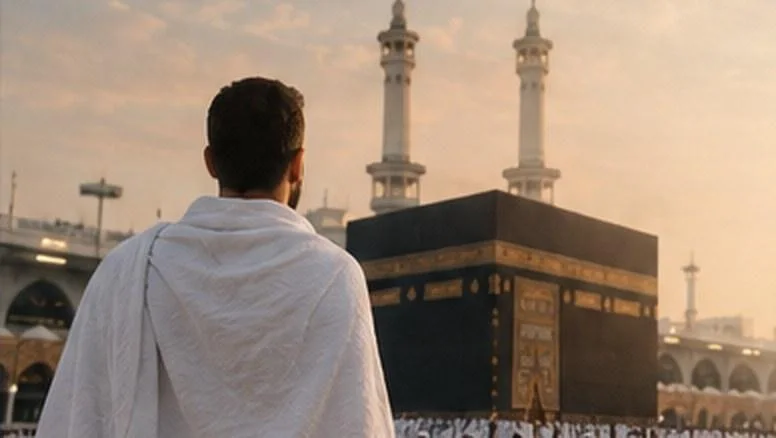
Your path to the House of Allah starts here
A complete Hajj and Umrah encyclopedia, and Umrah Badal for the deceased or those unable, with documentation that reassures the heart.
‹Rulings on Umrah Badal
What is its ruling? For whom is it valid? And how is it documented?
Learn the details
My experience with Wisal
Stories from people who trusted us with Umrah Badal for their loved ones.
A Wisal customer's experience with Umrah Badal for their parents will appear here, in their own words, after they agree to publish it.

How do we work?
Four simple steps to a blessed Umrah.
Who are you dedicating this Umrah to?
Choose the case and complete your order in a minute.
Wisal Packages
Hajj and Umrah Encyclopedia
View allFatwas and Rulings
Prohibitions, expiation and what is permitted for the muhrim.
ReadSupplications
Supplications and remembrances for Hajj and Umrah.
ReadMaps and Guidance
The route of the holy sites, with tips for getting around safely.
Where do you enter ihram?
Choose where you are to know where to enter ihram.
Place-based miqats
Dhul Hulayfah
For the people of Madinah and those passing through it.
≈ 450 kmAl-Juhfah
For the people of Syria, Egypt and the Maghreb.
≈ 180 kmQarn al-Manazil
For the people of Najd and Taif.
≈ 78 kmYalamlam
For the people of Yemen.
≈ 120 kmDhat Irq
For the people of Iraq and the East.
≈ 100 kmThose living within the miqats
For those living between the miqat and Makkah.
From their placeFor those in Makkah: Adna al-Hill
Aisha Mosque (Al-Tan'im)
The nearest point outside the Haram to the Grand Mosque, about 7 km away. The people of Makkah, and anyone staying there, enter ihram for Umrah from here.
Time-based miqats
When to enter ihram?
For Hajj: Shawwal, Dhul Qa'dah and the first ten days of Dhul Hijjah. Umrah may be performed on any day of the year.
Boundaries of the Makkah Haram
Boundaries of the Madinah Haram
Between Mount Ayr and Mount Thawr, and between the eastern and western lava fields.
Landmarks from the Seerah
Places linked to the life of the Prophet ﷺ in Makkah and Madinah.
Makkah
- The Cave of Hira (Jabal al-Nour)
- The Cave of Thawr
- Al-Hudaybiyah
- Al-Ji'ranah
- Mina and Al-Khayf Mosque
Madinah
- The Prophet's Mosque
- Quba Mosque
- Al-Qiblatayn Mosque
- Mount Uhud and its martyrs
- Al-Fath Mosques · Al-Baqi
Transport
In Makkah, Madinah and between them.
The development of Makkah and Madinah
From the Hijrah to the expansions.
Prayer Times of the Two Holy Mosques
Calculated astronomically using the Umm al-Qura method.
The Two Holy Mosques
Book your visit to the Rawdah
Booking is done through the official Nusuk platform.
Open the Nusuk app
Or its official website.
Choose the Rawdah permit
The Noble Rawdah in the Prophet's Mosque.
Choose a time and confirm
And keep your permit.
Stories, lessons and articles
Stories and Lessons
The woman from Khath'am, Sa'd ibn Ubadah and his mother, and the man who made Talbiyah for another.
Read the storiesWisal Store
Carefully selected gifts and essentials.
Quick answers
How do I know the Umrah was performed?
You receive documentation according to the chosen package, and you can follow the order status.
Is it permissible to request an Umrah for the deceased?
Performing it on behalf of the deceased is permitted according to the majority of scholars. The rulings will be reviewed before launch.
Can I request it for someone who is unable?
Yes, for someone permanently unable, as explained on the rulings page.
How long does the service take?
The duration is set after the order is confirmed.
What are the payment methods?
mada, Apple Pay and cards, activated once the payment gateway is connected.
Can I order for more than one person?
Yes, with a separate order for each person.
What is the difference between Umrah Badal and proxy Umrah?
They mean the same thing: performing Umrah on behalf of someone else, whether living and unable to travel, or deceased.
Is Umrah Badal permissible for living parents?
Yes, it is permissible if they are unable to perform it themselves due to old age or a chronic illness, and with their permission.
How much does Umrah Badal cost?
The price varies by package. Official prices will be set when the site launches.
How can I be sure the Umrah was actually performed?
You receive documentation of every stage, from ihram to completion, with a level of detail that depends on your chosen package.
Can the reward of one Umrah be dedicated to more than one person?
No, each Umrah is performed on behalf of one specific person, so a separate order is required for each person you wish to dedicate it to.
Wisal, the path of kindness and loyalty
About us: A service that arranges Umrah on behalf of parents, relatives, the deceased and those unable, and an encyclopedia of Hajj, Umrah, Makkah and Madinah.
Our mission: To be a calm and trustworthy path to kindness and loyalty.